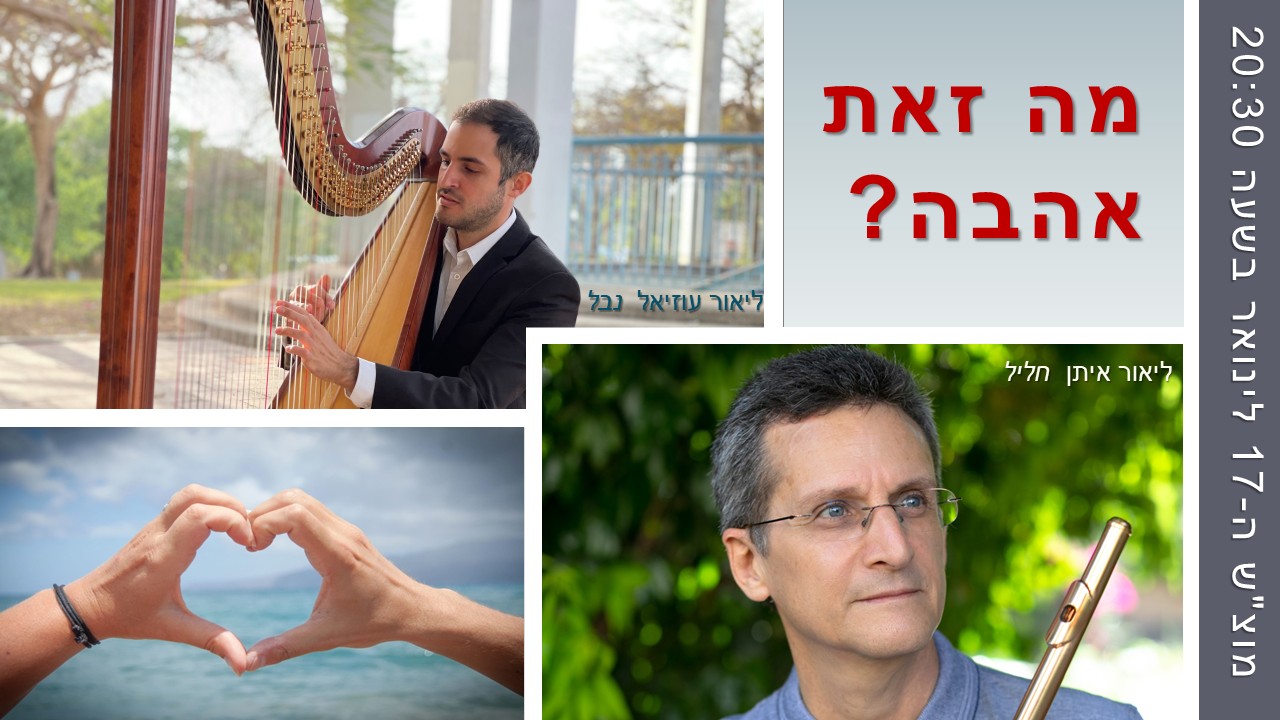
On Saturday night, January 17th, 2026, we hosted the concert "What Is Love?" in our living room overlooking Napoleon Hill, featuring flutist Lior Eitan from the Israel Philharmonic Orchestra alongside harpist Lior Uziel. The audience was treated to an exquisite performance — the gentle harp melodies and the airy flute tones seemed to wash over the soul, filling it with fresh energy. That’s exactly how I felt sitting there, listening in our living room next to my beloved partner. Yuval and I have been organizing cultural evenings like this for nine consecutive seasons now. I intentionally avoid using the word “concert” too much these days because, for many, it carries a weight or a meaning I won't even bother to describe. It’s enough to say that in our salon facing Napoleon Hill, the audience enjoys a vast array of musical styles. There’s no issue with getting up in the middle of a performance, refilling your wine glass, or savoring the various delicacies I lovingly prepare for our guests at every event. For me it is about "enjoyment" — for everyone!
Lior Eitan spoke to the audience before each piece, explaining the background of its composition and why it was chosen for the program on the theme of love. He also spoke openly and with great sensitivity about his love for his wife and the mother of his son — a talented bassoonist and a rare woman named Tzippi Shahori, who passed away before her time.
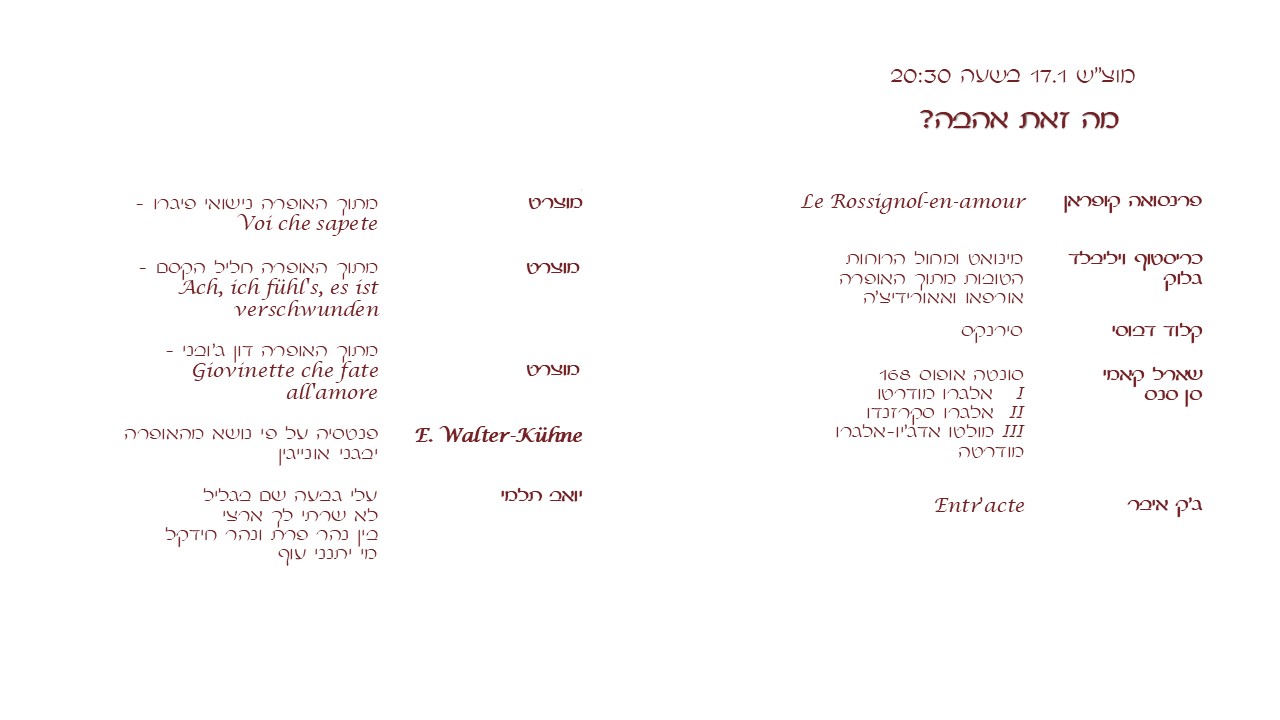
Lior the flutist and Lior the harpist journeyed through pieces about love, infatuations, and deep longing. Midway through the program, I joined in with my flute in hand to play flute duets by Mozart. We chose to perform arias from three of Mozart’s operas, two of which were written with the Jewish librettist Da Ponte. Before each duet, I explained the preceding scene and read a quote from the aria. This introduction drew both the listeners and us into the mood that matched the music we were about to perform. Evenings like these — unlike listening to or performing in a concert hall — are often especially moving because of the close connection between the musicians and the audience.
Below you can find our concert program as well as a few clips from the performance. Many of our programs can be viewed live on-line and can also appear in private home/halls/worldwide at various occasions. Call Tamar for details or email me: +972 54 3039868 melzer.tamar@gmail.com
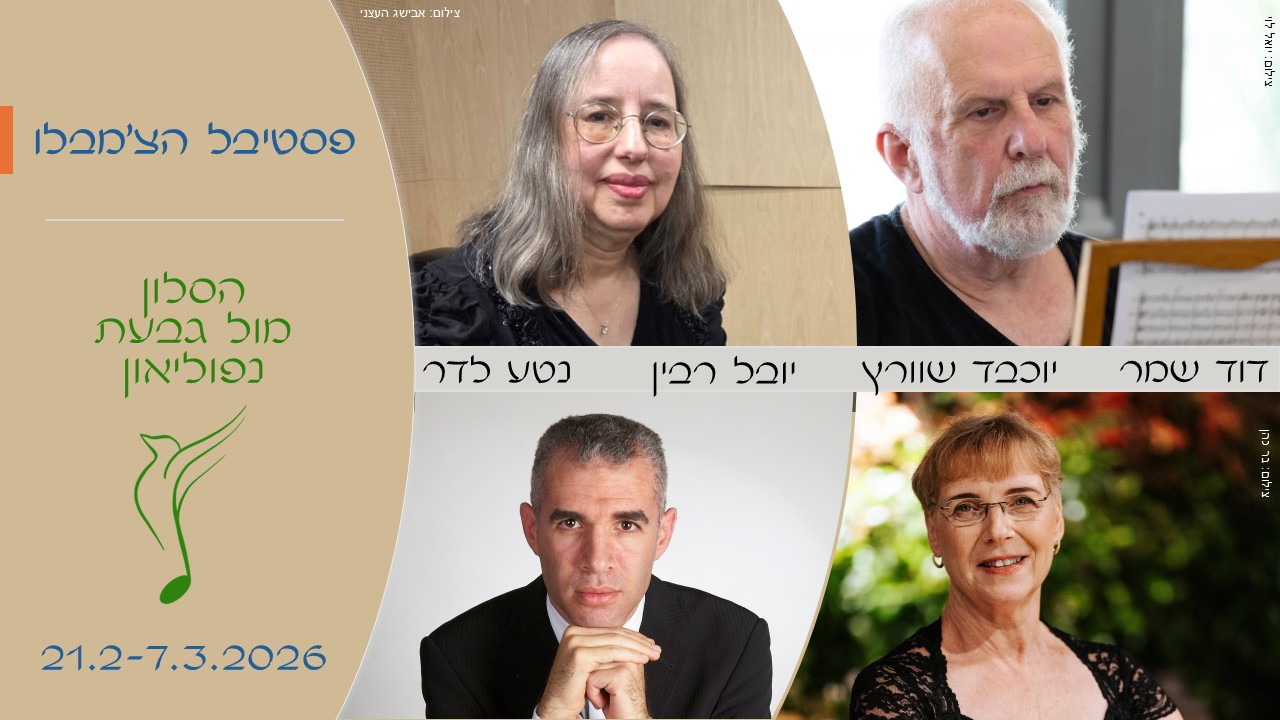
The upcoming salon evenings planned for February-March will feature a festival of Israeli harpsichord players: David Shemer, Netta Ladar, Yuval Rabin, and Jochewed Schwartz will perform programs close to their hearts — programs into which they have invested years of research and deep exploration. Performers of historical music are typically musicians who seek an even deeper connection to the sound, the touch, and the result that is as close as possible to the "authentic" — though, of course, no one really knows exactly what "authentic" was. We have a wealth of written information: surviving books and descriptions detailing the playing style, the performance, and even the recommended diet for a performer and the physical activities suitable for someone pursuing a musical career. But in the end, even if a historical instrument has survived, we still don't know enough. Every piece is like a nut that the performer must crack. Every composer has their own unique language, and when a performer studies a work, they aim — in my view — to crack the code of the composer’s language. How do you know when it’s successful? When it’s "it" — the performer feels it, and the audience will feel it too.
For more information, please press below:
We'll be happy to see you in our music lounge in person or on-line!