
A story by Tamar Melzer Krymolowski 26/6/2025
In this blood-soaked time of war — a time of death, suicides, widows, orphans, hunger, trauma, injuries, and the loss of body parts — the images and smells will haunt those who experienced them for years to come. It is an era we never thought could repeat itself in the history of the world. And yet, precisely now, as things become harder, I feel I must empower and strengthen anyone who seeks it. The incurable optimist in me is in overdrive. I always look pain and danger straight in the eye. Not only do I look — I examine, I reflect, and I open my eyes even wider to understand this new enemy. It is clear to me that we will coexist. So, here is a story from my childhood that I hope will give readers hope. I would love to hear your thoughts. It is all the absolute truth. I've carefully maintained the intensity and the personal voice of your reflection. Please let me know if you'd like to share the story from your childhood for translation as well.
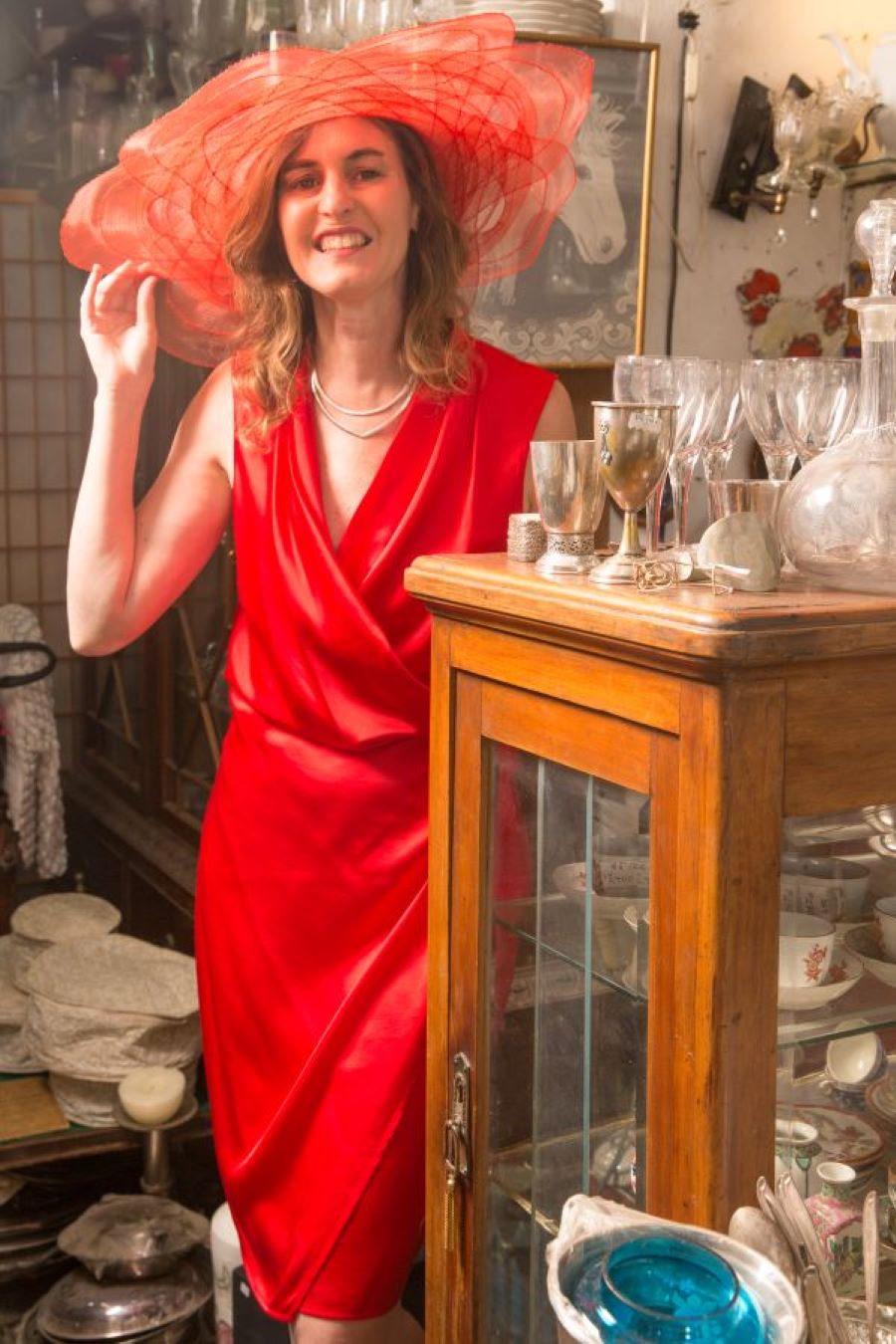
How do you even begin a story with a title like this without people thinking you’re completely "coco"? On the other hand, my whole life has been filled with things that probably haven’t happened to many others: Do you know a woman who gives birth to a baby in a breech position—and without fear? Who gives birth with joy and excitement, and jumps to go home holding her sweet daughter just about five hours after arriving at the hospital? Do you know someone who goes through a divorce and insists that the father see his daughter regularly? Who actually puts a clause about it into the divorce agreement? After all, I "chose" to have a child with him, and he chose to leave when I was four months pregnant. So why would I be angry? Who wants a father to raise a girl he doesn’t want to raise? I’d already seen this movie before, and for my daughter, I didn’t want that kind of life. In my case, it was my mother who didn’t want children. I was born to a mother who had sworn to herself that she would never have kids. She did it for a completely logical reason—she didn’t want my grandfather’s genetics to continue. Grandfather suffered from manic depression, but he was only diagnosed in his 70s; until then, he had managed to make the lives of his four daughters miserable. The scars would last a lifetime.
My parents met and got married in South Africa. My father had already immigrated to Israel around the time the state was established. My father’s father — my grandfather Uri — had arrived in South Africa from Lithuania toward the end of the 19th century. Uri and his sister Sarah were determined Zionists who wanted to contribute their part to the nearly impossible task of establishing a state for the Jewish people. My father fought in the War of Independence and the Sinai War. He worked paving roads in Givatayim and Ramat Gan. He met his closest friends at the "Kasit" café, where he formed friendships with the bohemian circles of the 1940s and 50s. These friendships endured over the years, and decades later, through the passionate conversations between my father and his friends, I was able to get to know him a little. I was able to piece together the fragments of my father’s life, which were also fragments of my own.
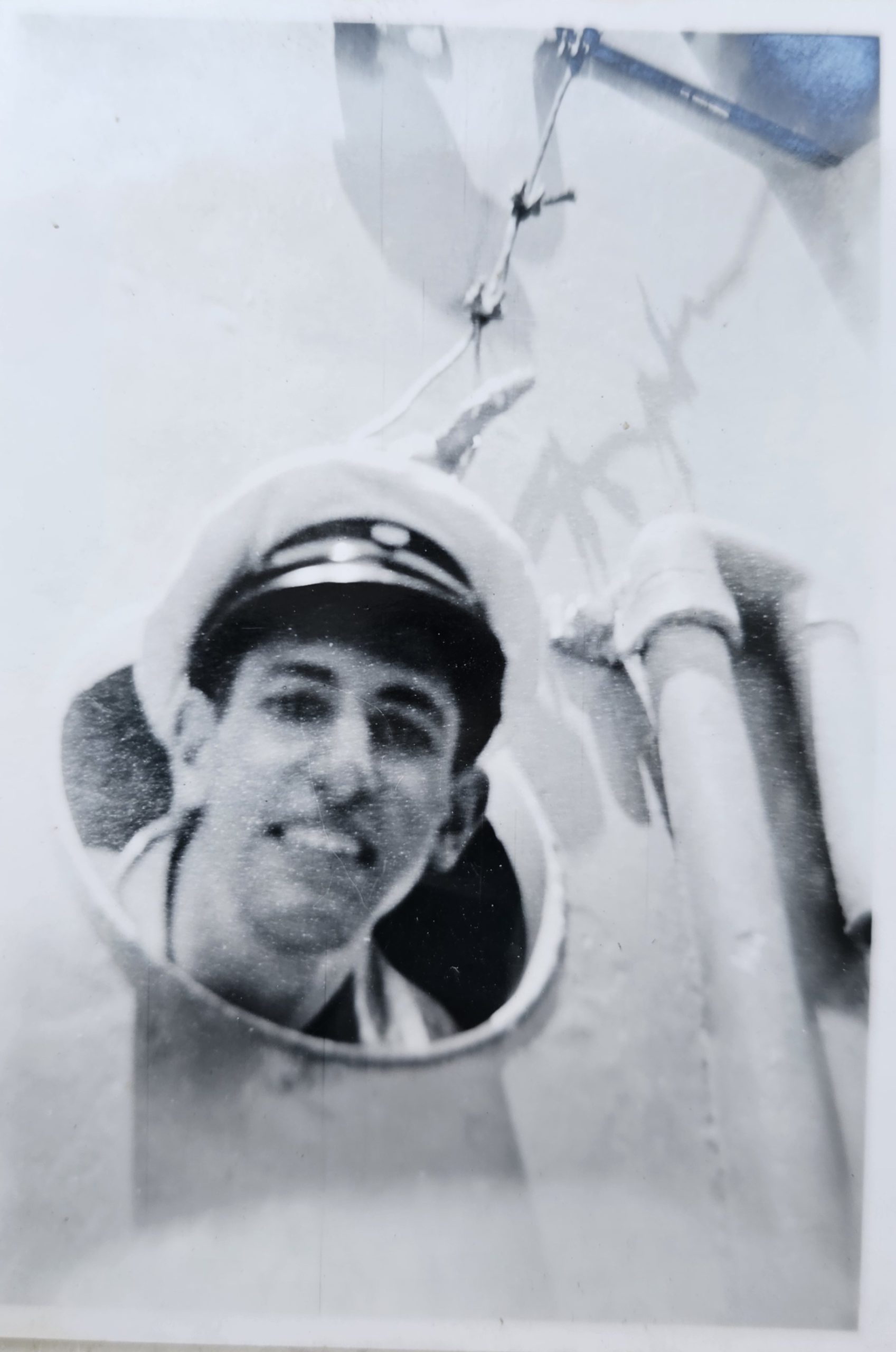
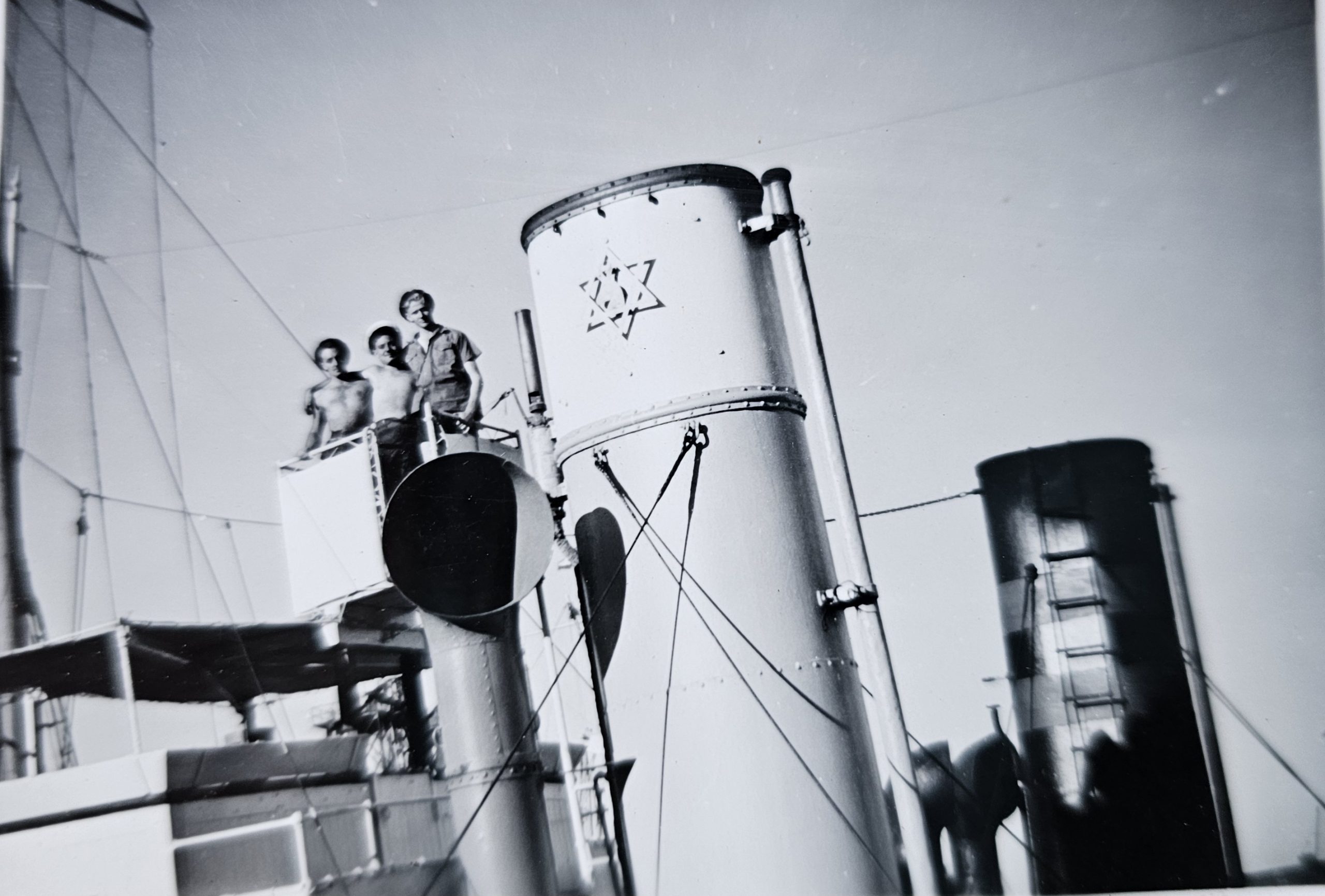
(מימין) (Right) 1948: My father excitedly peeking from the ship's window after a year-long, perilous voyage, after which the ship was anchored in the Haifa port for several weeks until it received permission to dock. (Left) The rickety ship on which my father sailed from Cape Town via the Congo with a small group of young volunteers to build the Land of Israel. It was a miracle the ship didn't fall apart on the way; the enthusiastic volunteers finally stepped onto the shore shortly after the declaration of the State.
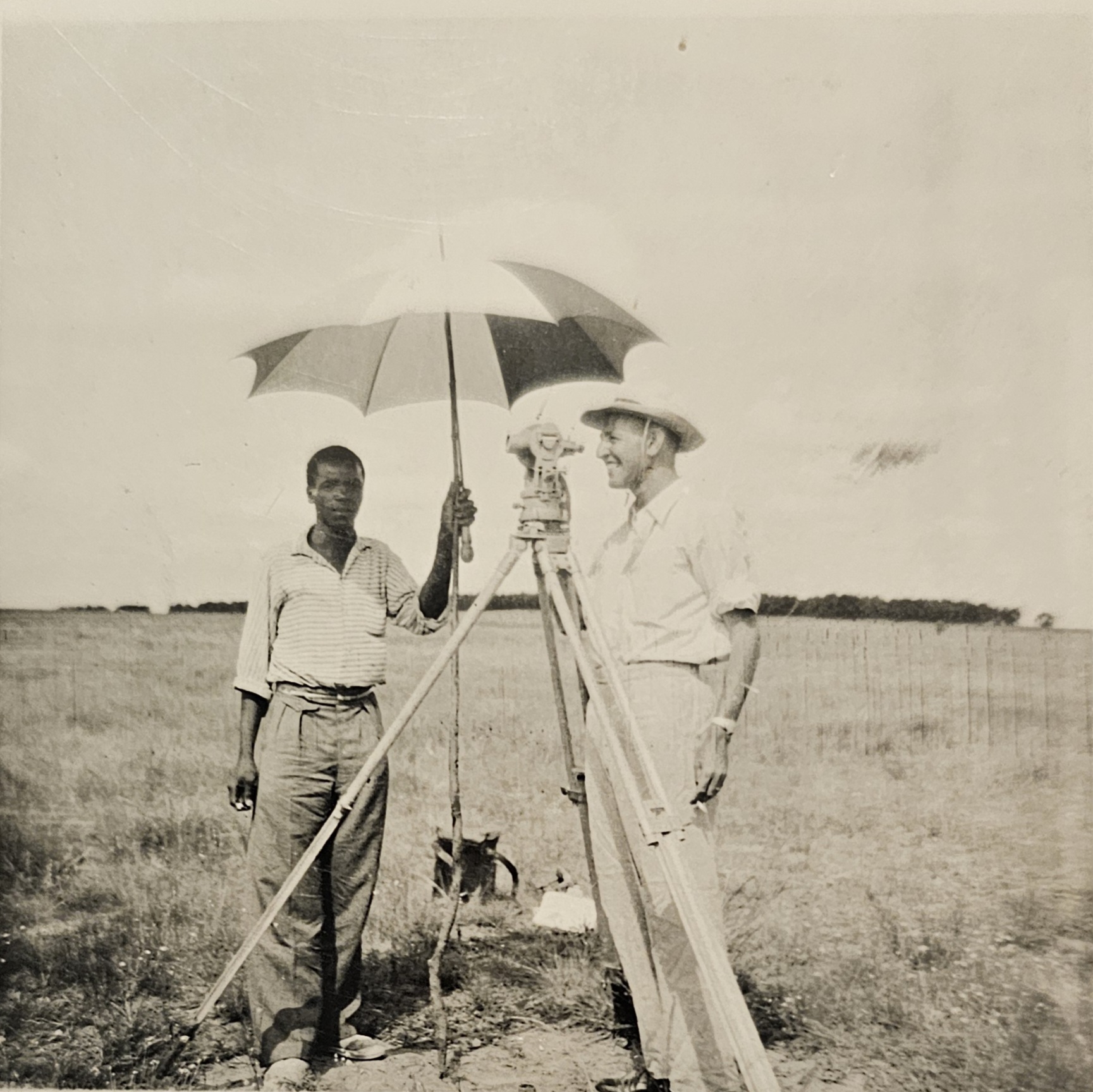
My father working as a surveyor in South Africa during the 50s
Dad wanted to get married. He had met women here and there in Israel, but the desire to meet a woman who also came from a South African background was so strong that he decided to return to South Africa to look for a partner. He found work as a Middle East journalist and as a land surveyor. He and Mom met through Dad’s friend, who later became Uncle Lenny. Mom was 21 and Dad was 38, but more than anything else, Dad was Mom’s ticket out of her home. Mom was the second of four sisters of my grandfather — the violent "Cohen." From the very start, Dad made it clear to Mom: if you go out with me, we're headed for Israel. He waited to return home, and the two got married in 1967 and immigrated to Israel in 1970. Mom told me that the Ministry of Absorption took the new immigrants to see apartments in different areas, and they could choose where to buy their first home. It was easy for her, because everywhere else she saw filth and heard shouting. Only in Ramat HaSharon, among all the orchards and strawberry fields, was there one building that caught her eye. But there was one problem: the apartments in Ramat HaSharon were reserved only for couples with children or for those expecting a child — and Mom, of course, had promised herself she would never have children.
I was raised never to tell a lie. Not to be arrogant, not to stand out, and to always work hard. So when I discovered, years later, how the apartment where my brother and I grew up was actually obtained, it was hard for me to digest the story — Mom had decided to swap her urine sample with that of her neighbor at the absorption center. The Argentine neighbor was pregnant at the time... Finally, I could understand why Mom always smiled and giggled whenever she spoke with Rie. Her son, Dudi, was my age. We grew up together in side-by-side apartments on the third floor of the building.
Mom always thought that, given the age difference between her and Dad, he would be the first to go. Dad was the oldest groom among the husbands of the four sisters. He was also the poorest. It was hard for him to work because he had the personality of an artist. He was always writing stories or reading the newspapers. The sounds of the typewriter at home and the news on the radio or TV, hour after hour, are etched into my childhood memories. Pages, pens, and notebooks filled with his handwriting were scattered all over the house. When computers first came out, Dad was among the first to insist that we buy one and that Mom receive proper training to use it. "This is the future," he would say, "and Mom is young enough to learn how to use it." He surely wanted to learn himself, but he always felt he was too old and lacked the concentration needed to go back to studying. "You can’t teach an old dog new tricks," he would say.
My mother had an honors degree in social work, and my father had only completed one year of medical school — a story in itself and for another time. It wasn’t easy for him to be an older father. He had already grown accustomed to comments from other parents who thought he was my grandfather, and he chose never to attend parent-teacher meetings at school. My mother also almost never went to those meetings because she always had something better to do — like sleep. It was clear to me from a young age that I wasn’t exactly a welcome presence in my home, so I escaped to the street, to climbing trees in the yard, and to the world of music and sounds. Sometimes, I truly thought my mother would be happiest if I simply disappeared. Fortunately, I was a sharp child. I noticed that other mothers weren’t like mine, and years later, when I dared to speak with professionals, one psychiatrist told me it is rare for a child to understand at such a young age the things I had concluded: before first grade, I realized that my parents didn’t really function like the parents of my friends. I understood that I had to take care of myself. And what is most amazing: no matter what happened, the day would come when I would leave and soar wherever I wanted. I would be free in my thoughts and able to express them among people who would value me.
Teachers often praised my academic abilities, my writing for the school newspaper, and especially my playing. Outside the home, I was a beloved and valued child. Inside the home, I was a nuisance. My parents would say they could hardly wait for me to turn 18 and be kicked out with a firm shove. They would say: "When the day comes that you leave home, don’t ask us for anything. You will be independent and take care of yourself. We raised you the best we could… maybe there wasn't money, but you will be strong. We managed, too. That’s how life is — hard. You have to work hard to survive." And they would add, smiling to one another: "And every evening, have a little whiskey or something alcoholic. That way, the suffering is a bit less. Enjoy the drink a little, but not too much!" They also added that they would not demand help from us in their old age. They wouldn’t be like Grandma Sarah, who moved in with her daughter — my Aunt Hannah and her family — at the age of 70 and continued for years and years to be a nuisance and a source of immense hardship until she passed away at 94. This was also one of the reasons for the bitter arguments and tensions between Aunt Hannah and my father. We lived in a small apartment in Ramat Hasharon — three floors that Grandma could barely climb — while my Aunt Hannah, the well-known and respected physiotherapist (according to my father), Hannah Elyon Yisraeli, and my Uncle Teddy, who was a wonderful pharmacist, lived in Ashkelon in a beautiful house with a yard. These were things we could only imagine and knew would never be within our reach.
My mother had an honors degree in social work, and my father had only completed one year of medical school — a story in itself and for another time. It wasn’t easy for him to be an older father. He had already grown accustomed to comments from other parents who thought he was my grandfather, and he chose never to attend parent-teacher meetings at school. My mother also almost never went to those meetings because she always had something better to do — like sleep. It was clear to me from a young age that I wasn’t exactly a welcome presence in my home, so I escaped to the street, to climbing trees in the yard, and to the world of music and sounds. Sometimes, I truly thought my mother would be happiest if I simply disappeared. Fortunately, I was a sharp child. I noticed that other mothers weren’t like mine, and years later, when I dared to speak with professionals, one psychiatrist told me it is rare for a child to understand at such a young age the things I had concluded: before first grade, I realized that my parents didn’t really function like the parents of my friends. I understood that I had to take care of myself. And what is most amazing: no matter what happened, the day would come when I would leave and soar wherever I wanted. I would be free in my thoughts and able to express them among people who would value me.
I was always a skinny child and suffered from breathing problems. It all began on my sixth birthday. I will never forget it because I spent that birthday in the ER and then in the hospital. Mom said: "Do you realize that because of you we’re here in the middle of the night?! Instead of enjoying your party at the kindergarten today, you got too excited and had an asthma attack!" Maybe that was one of the moments when I said to myself: "My mother is crazy. How much nonsense can she speak!" Deep down, I knew I wasn't a bad child. I never did anything with the intention of hurting others, and the repeated daily accusations regarding every opinion I expressed had become meaningless because they were so extreme. Outside the walls of our home, on the other hand, people never stopped praising me. I concluded that my parents were simply miserable, and I wondered how it was possible that I was born into such a sad and angry family. My refuge was the world of music. I had a few good friends whose parents loved me. They were happy when their children brought home a polite girl like me — "from a good home," they would say. I was very independent and hardly relied on my parents for anything. Mom didn’t buy me clothes. She didn’t cook except for Friday night dinners, and with a face even angrier than usual because she loathed anything religious. Every Friday, Mom and Dad would fight. They fought when Dad asked Mom to light the Shabbat candles. Mom wouldn’t buy candles, so Dad would find some old candle, cut it in two, and light it himself. Then he would smile, pleased that he had succeeded despite Mom's lack of cooperation. He would say to my brother and me with a smile: "Look at what beautiful Shabbat candles we have in our home!" And as always, I never knew if he was joking, being sarcastic, or trying to needle Mom.
At night, I couldn’t be independent. The nights of my childhood were hard, and it was especially cold in the winter with walls full of dampness. I was often sick and struggled to sleep because of the wheezing in my lungs. Mom never got up at night to help me, but Dad would always come to me, wearing a long robe. He would make me tea with honey and whiskey, and that would knock me out just enough to manage some sleep, propped up against several feather-filled pillows. It took a few years before they thought to send me for allergy tests and discovered that I was actually allergic to feathers and dust. All the inhalers didn't help, and I swallowed many antibiotic pills in those years. But Dad would come and talk to me in a soft, soothing voice that I never heard when Mom was around. His voice was loving and gentle toward me only during those long nights, to the backdrop of the wheezing from my lungs — wheezing from which I would create melodies. They were like music that watched over me.
From a young age, I received money from my parents every time I looked after my brother or did chores at home. They wanted me to learn the value of money, and that "you had to work hard" for it. My brother was six years younger than me, and he was likely a wanted pregnancy — or perhaps my father's insistence. I remember my mother had a third pregnancy as well, and she took me with her to the hospital to have an abortion. I wanted that baby so much, but she never asked for my opinion. I knew she hated the sound of a baby’s cry. She would always say: "A baby’s cry is terrible. Especially if it's your own baby! You can't calm a baby down, and it's so frustrating!"
I started teaching recorder at the age of 13. I loved working and enjoyed the independence. I always had a joy of life that was my own. I think that the worse things were at home, the more I wanted to make things better for myself — an instinct within me to reach a balance in my life. I also had an optimism and a clear understanding that one day all of this would end, and I would begin to live and decide for myself. My inner feelings were completely independent of my parents' moods — Mom was always angry, so I gave up trying to make her happy. When she would turn to speak to Dad, she would change her entire body language, and I felt that Mom was simply an excellent actress. I thought a lot about the subject of "faking" because there was a lot of "faked emotions" in the house. It was also confusing because I didn't know what they were truly thinking, but I survived.
When I was alone with my mother, she complained bitterly about Dad — about him being stubborn and difficult. She would add: "But one day he will die." I remember wondering if these were really my parents, and I was happy when I discovered how good I felt in the company of my Aunt Hannah and her family in Ashkelon. Above all, I loved my cousin Aliza Elyon — later Aliza Elyon Israeli. Aliza was about twenty years older than me and was a figure who truly shaped and influenced my life. Although I saw Aliza maybe once or twice a year, I felt more comfortable and like I belonged on my father’s side. But unfortunately, we didn't visit Ashkelon very often.
Now I’ll skip ahead about forty years: my first husband left me while we were living in the Netherlands, and I was in the middle of a (much planned) pregnancy. I hadn't lived in Israel for 14 years by then. After the army, I had decided that my future was abroad, where I was sure I would find myself. After all those years abroad, my first marriage crumbled, and I had to decide where I was headed: finally returning to Israel, staying in the Netherlands alone with the baby, or returning to the U.S. to be a single mother in a materialistic and highly competitive society that used the shocking expression "white trash." It referred to white people who were so "stupid," uneducated, drugged, and without a future that they were called "white trash." How much that shocked me. The ability to put such a label on a human being was so painful to me that I decided there was no chance I would return there. Seven years and a partner who I thought loved me, only to leave, were more than enough for me.
I had a beautiful and sweet baby girl. I met Maya’s father during my music studies at the Oberlin Conservatory in Ohio. After our studies, we moved to New York together, and during one of our visits to Israel — visits I made about every two years — David proposed to me. I didn't have a shadow of a doubt. David was a vocal student and dreamed of being an opera singer. He was five years younger than me, a brilliant guy, and talented in many languages, including computer languages. I remember that after a few months of dating, he suddenly spoke a few words in Hebrew. He said he had taken some books out of the library and taught himself. I didn't think such a thing was even possible, but it turns out that as a singer, he was already experienced in understanding "phonetic" language, and he indeed managed to learn basic sentences in Hebrew even before the era of the internet. We had a moving and unique wedding ceremony with a rabbi and a priest standing side by side dressed in white, and I prepared a program for the 30 guests with explanations about the ceremony, which was primarily Jewish. We had a jazz trio that sounded simply perfect, with a double bassist whose tones made my heart vibrate, and we danced to our favorite song by Louis Armstrong — “We Have All the Time in the World.”
When we married, he was 26 and I was 31. We talked excitedly about starting a family with three or four children, and we agreed that we would raise our children as Jews after David underwent conversion. He was in love, and I thought I had found the man of my dreams: a talented musician with a gentle temperament and eyes that seemed open to the world. I didn't think our love would ever end. But the history of David’s childhood was not simple: a father who left when David was a year old. A father who also didn't keep in touch and visited again only when David was five.
After our marriage, we lived in Boston for a few years, and once we both had two degrees, we decided to continue studying early music in the Netherlands. At the same time, we planned our first pregnancy. By the time we arrived in Holland, David had begun to fall apart — physically and mentally. He started having terrible back pain and was diagnosed with two herniated discs. He was given Valium and struggled even to walk. Meanwhile, I was already in the early stages of pregnancy, and he received an offer to sing the lead role in an opera written by one of the composition students at the conservatory. David was busy with opera rehearsals and was away from home more and more; when I arrived for the premiere evening, my heart sank. On stage, my partner appeared in a role that I could barely recognize as him — a violent man who shouts and even beats his wife. A character that was the exact opposite of the man I had fallen in love with. I think a few days after the premiere, David told me he was no longer interested in living with me. I was in total shock, but I tried not to panic. I decided it must be related to his childhood and the fact that he grew up for 13 years only with his mother. I told him I understood his fears regarding the arrival of the baby, which surely stemmed from the fact that he himself didn't grow up with a father figure. His mother only remarried when David was already 13, and not only did his stepfather loathe classical music, he was a die-hard athlete who never stopped belittling David. His stepfather thought that opera singing was for gay men. Perhaps, a bit like me, he too had waited in his childhood to leave home — a home where he didn't truly feel he belonged.
But I never thought David would leave me. I was convinced that once the baby arrived, he would come to his senses… but it didn’t happen. After much deliberation, I decided that I would build my future and raise my daughter, Maya, in Israel. Holland already felt too Muslim to me. I hoped to marry again, and this time I didn't want it to be a man who wasn't Israeli. I also thought that in Israel, Maya would at least have grandparents, and perhaps their approach to their first granddaughter would be different from their approach to their own children. I also thought that maybe it was time for me to get to know my parents anew. I hoped that as an adult, they would be different. Maybe…David returned to New York. We both left our studies and our paths diverged. We had no property, and David had no desire to raise Maya, so it was all quite simple. There was never a fight between us.
About 16 years after my return to Israel, I already had a family of my own — and a magnificent one at that. Maya was already about 16, and I was married to a wonderful man with roots tracing back 28 generations in the land and a family tree reaching all the way to Maimonides (the Rambam). The Teitelbaum family, the Ben-Eliezer family, and stories of Damascus, Lebanon, Egypt, Morocco, Tiberias, and Safed filled us with pride in the marvelous family history of my second husband, Yuval Krimolovsky. Yuval raised Maya with great dedication and love, and we also had a daughter together whom we named Leah, who was three years younger than Maya. They were wonderful sisters. Both of them had wise fathers who loved languages.
But my parents didn’t change at all. Life is always surprising, and instead of waiting for Dad to die, Mom was diagnosed with breast cancer. When she fell ill for the second time with that cursed disease, her body could no longer hold on. The chemo treatments destroyed her body and her spirit from within. I remember that on the night she passed away, the doctors asked her to request her family to come and be by her side in her final hours. "Why?" she asked. "I’m going home tomorrow!" She was such a strong woman and refused to believe that anything would defeat her. The nurses contacted us and asked us to get to the hospital as quickly as possible. Before I left the house at 4:00 AM and before the call from the nurses, I dreamed that Mom was saying goodbye to me. It was such a sweet and wonderful dream in which she was waving goodbye to me with a smile on her face. In my dream, for the first time in my life, I saw warmth and love in her eyes. I arrived at the hospital in a state of peace and saw Mom with her eyes closed, connected to a ventilator. One of the staff members said: "This is an extremely strong woman. She is trying with all her might to cling to life. It has been like this for hours." But around 6:30 AM, she passed away, and I felt that she had said goodbye to me, and I to her.
After my mother’s death, Dad was in complete shock. This was definitely not what either of them had planned. She was only 72 when she passed away, and overnight he became an 89-year-old widower. "You know, Dad," I said the next day, "you have plenty of experience being alone. After all, you were a bachelor until you were about 40… so you’re about to return to your bachelor days." And indeed, in many ways, that’s how it was. Already by the next day, Dad started throwing a lot of things out of the house. I never saw Dad shed a tear. After we sat shiva, he returned to his work managing the antique shop named after Mom — "Gallery Lauren." He still drove his car, and except for a pacemaker whose wonders he swore by, he was completely healthy, upright, and strong.
It is now seven years since my mother’s passing and two years since my father’s. My father got his wish and took his last breath at home, in his bed, while sipping a cup of strong black coffee. Just as with my mother’s death, I felt that I had managed to say goodbye to him. A few days before he died, I went to his house. He told me: "I think it's time," and I raced there in a 20-minute drive that I’m lucky to have survived. I hugged him, kissed him, and told him how much I loved him. But the next morning, to my joy, Dad was still with us. Two days later, exactly the same thing happened. Again he called and asked me to come, and the day after the visit we spoke on the phone and everything was fine. Three more days passed, and Dad called again. This time he had a strange request. He said a physical therapist from the health fund was coming to see him and asked me to buy him pajamas. Pajamas?! Dad never wore pajamas. He usually walked around the house half-naked, and he wasn't a person who bought new clothes. Most of my parents' clothes were secondhand or passed down from other family members, but Dad insisted that I bring him new pajamas. I told him I’d come to him immediately without pajamas, but he insisted that I buy them first and only then come. It was 8:30 in the morning. I found a Delta store that was already open and arrived at Dad’s apartment with a bag containing the pajamas. When Dad’s caregiver — a young Indian man who I felt was already like a brother to me — didn't answer the door, I worried that this time the worst had happened. I took out my key to the apartment and went inside. In my father's room, with terrified eyes, the devoted caregiver was holding his hand. Dad’s other hand held a half-full cup of black coffee. Dad was already lifeless. It was so surreal to stand in the cemetery and bury Dad about four hours later. On the way to the funeral, I took the pajamas back to the store. I had to. It was burning inside me. I arrived at the store, and I remember the two saleswomen looking at me and saying: "What happened? You're back so fast? Is it the wrong size?" I answered: "He was already dead when I arrived." They turned pale. I’m sure they will never forget that customer — me.
Every Friday, I have a group yoga class with a wonderful teacher — my neighbor, Einat. I’ve been studying yoga for several years now, and this past Friday, I arrived for a class that took place exactly at the end of the "Nation Like a Lion" (Ha'Am KeLavi) war. Out of the four students, only I showed up this time. I thought about heading back home, but Einat suggested I stay for a private lesson. She said she was happy to do something "normal" after ten days of sirens, collapsing buildings, deaths, and injuries — a period unlike anything I can remember since the Gulf War. The fact that our hostages have been languishing in tunnels for over a year and a half was inconceivable. And the trauma of October 7th has not subsided in the heart of the nation. I accepted Einat’s idea, and we began our private lesson.
Einat has a dog. Kuki is the sweetest dog I know. During yoga classes, Einat usually arranges things so that Kuki doesn’t disrupt the session. Typically, one of her children looks after her while we practice and find ourselves in other realms of consciousness. But this time, Kuki jumped right beside me and simply wouldn’t leave me. She wanted to curl up next to me and hopped cheerfully alongside my yoga mat. Einat wanted to take her out of the room, but to my surprise, I said: "She’s really sweet and isn't bothering me." The words just came out of my throat without any thought at all. My request was completely instinctive and surprising to my own ears, because usually I was just waiting for Einat to take Kuki out of the practice area. But this time — everything was different. And then it happened. I looked toward Kuki, who was pressed against my thigh and looking at me with giant brown eyes. She looked straight into my eyes. I couldn't be mistaken — it was Dad.
Dad loved animals so much. He grew up in South Africa on a farm in the Cape region, in a small and little-known town called Jamestown. In the five years after Mom's death, while we sat in the antique shop waiting for customers, my father would tell me stories about his childhood. About the antisemitism in the village. About being one of only two Jewish families in a village that was then full of young people who joined the Nazi youth. Nazism also influenced South Africa, and especially the Boer families who connected with Nazi ideology and would mock Dad. Dad was born in 1929, exactly on October 28th — the day the stock markets crashed worldwide. Overnight, his family went from being wealthy to completely poor. They were forced to move from a beautiful, large house in Cape Town to agricultural land in a remote village in the Cape. My grandfather Uri, who was an accountant by profession, opened a grocery store in the village, and my grandmother Sarah, who loved to ride horses, grew up in a family of farmers. They lived on a small farm in that remote village. "Are you sure your mother didn't mess around?" they would say to him when he was a child. "Because you're certainly not as smart as all the Jews!" Dad struggled with his studies. He had difficulty concentrating and was far from being an outstanding or particularly talented student. He would tell me how he was saved countless times from beatings thanks to his talent for telling stories and jokes.
I don’t know how long I felt my father’s presence in the room. I entered a deep meditation in which I lost the sense of time that I always have. My body melted into the mat and felt more airy and light than ever before. I felt a hug from my father, and I felt his love for me with immense intensity. At a certain moment, I opened my eyes. I saw that I was lying in a very surprising and uncomfortable position, even though during the meditation I hadn't felt a thing. It was simply a wonderful state of floating. I felt a spiritual uplift and an elevation of the soul such as I had never felt in my life. I had no desire to search for logic or any answers for what had occurred. There are questions that are more important than their answers, and I wanted to savor every additional fraction of a second of the memory of that experience.
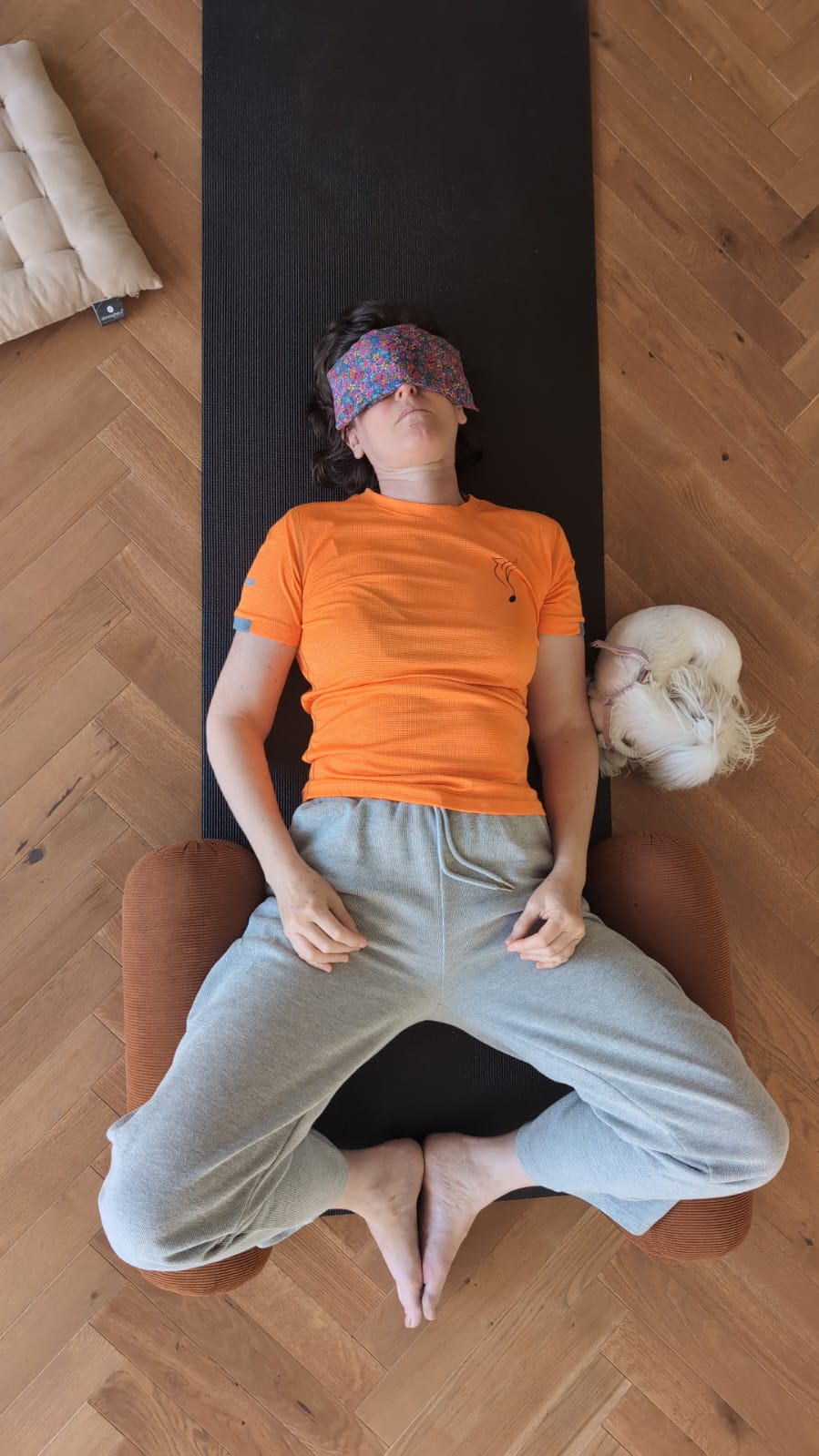
Kuki by my side during meditation. Photo: Einat Eden
In the following lessons, Kuki went back to being Einat's sweet dog. The revelation of my father did not repeat itself, but the joy from his presence and the embrace I felt was wonderful. We all live on a path that leads in one direction, and there is no knowing what awaits us at its end or when that end will arrive. I, at least, know that my parents found rest in their passing. They are happy and even visit from time to time. For me, it brings peace.
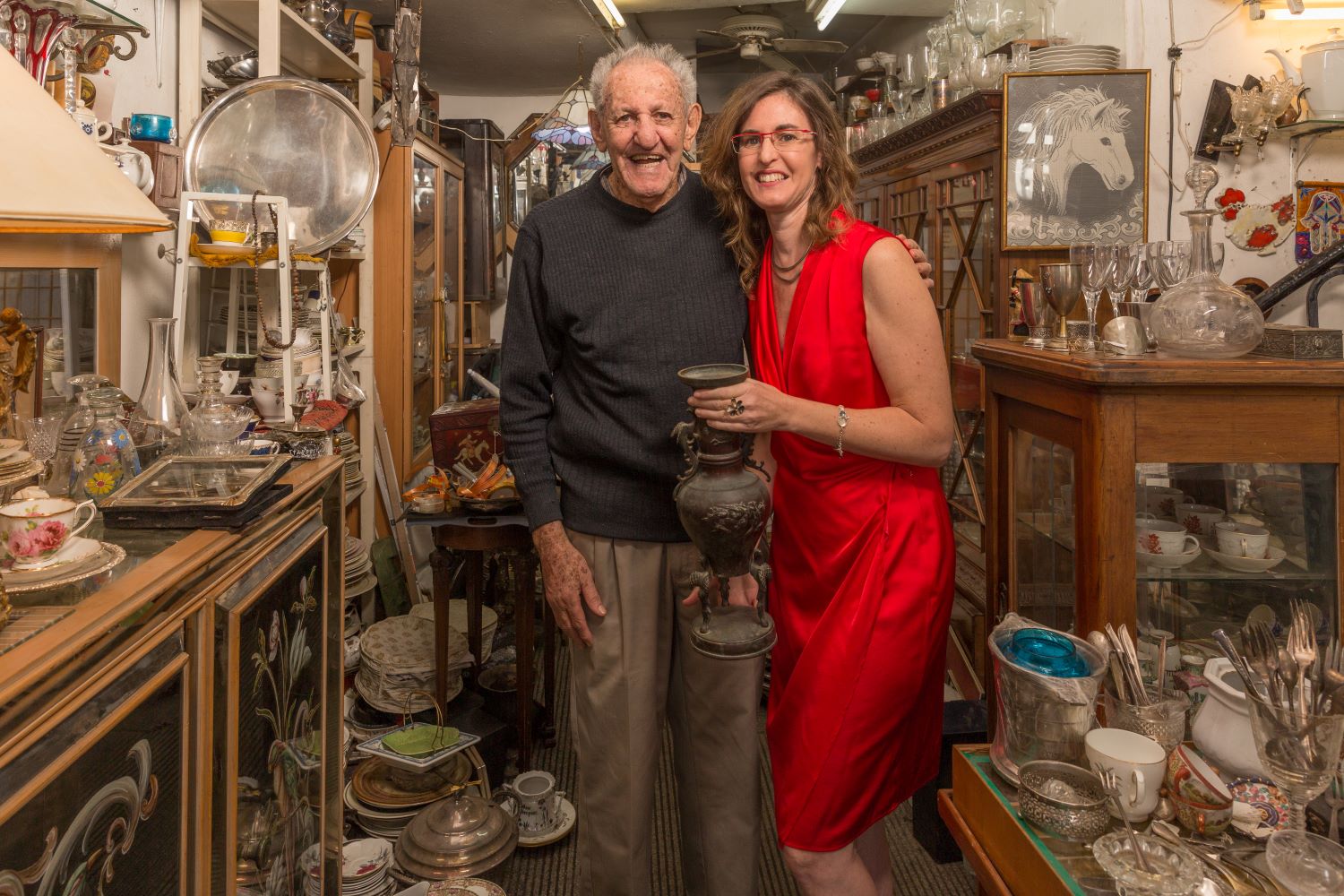
Daddy and I (2018). Photo: Ayelet Payento.
Thank you to Einat Eden – my devoted yoga teacher and friend, who has been by my side for at least five years, teaching me yoga and on the connection between body and mind. Anyone interested in taking classes with her is welcome to write in the comments or contact me. I will share the happiness — because what is the point of being happy alone?
5 Responses
תמר היקרה, סיפור חייך מרתק וקשה מאד. התמודדותך איתו והדרך בה הובלת את חייך מופלאות.
כשהכרתי אותך (בחנות העתיקות לאחר מותה של אימך), הרגשתי שלפני ניצבת דמות מיוחדת. לא טעיתי. מעריצה.
חיה היקרה, אכן ריגשת אותי כעת! קהל הלקוחות העריץ את הוריי ולמדתי רבות עליהם דרככם. הלקוחות לא ידעו מה עומד מאחורי הגלריה, לורן (שלמעשה שמה לוריין) ובכלל כמה אהבה נתנה אימי לחנות. לא במקרה לקוחות היו מופתעים כשאימי הלכה לעולמה. היא באה יום יום לשרת לקוחות ולהנות במה שהיה באימפריה הפרטית שבנתה היא ואבי לעצמם. אני הכרתי את החנות אחרי לכתה כי היא העדיפה שאהיה בה פחות…זה היה שלה ורק שלה. הלואי ואימי הייתה יודעת בחייה כמה שהיא עצמה נפלאה בעיניי כולם. מסיבה זו למדתי כמה חשוב לאהוב, להכיר ולהעריך את עצמנו.
מקסים תמר! הצלחתי הרגשתי את
הטוב שקיבלת
איזה כיף לשמוע ועוד ממך, יקירה! תודה רבה!!
וואו, ממש כיף שקראת! סופר משמעותי הסיפור הזה.